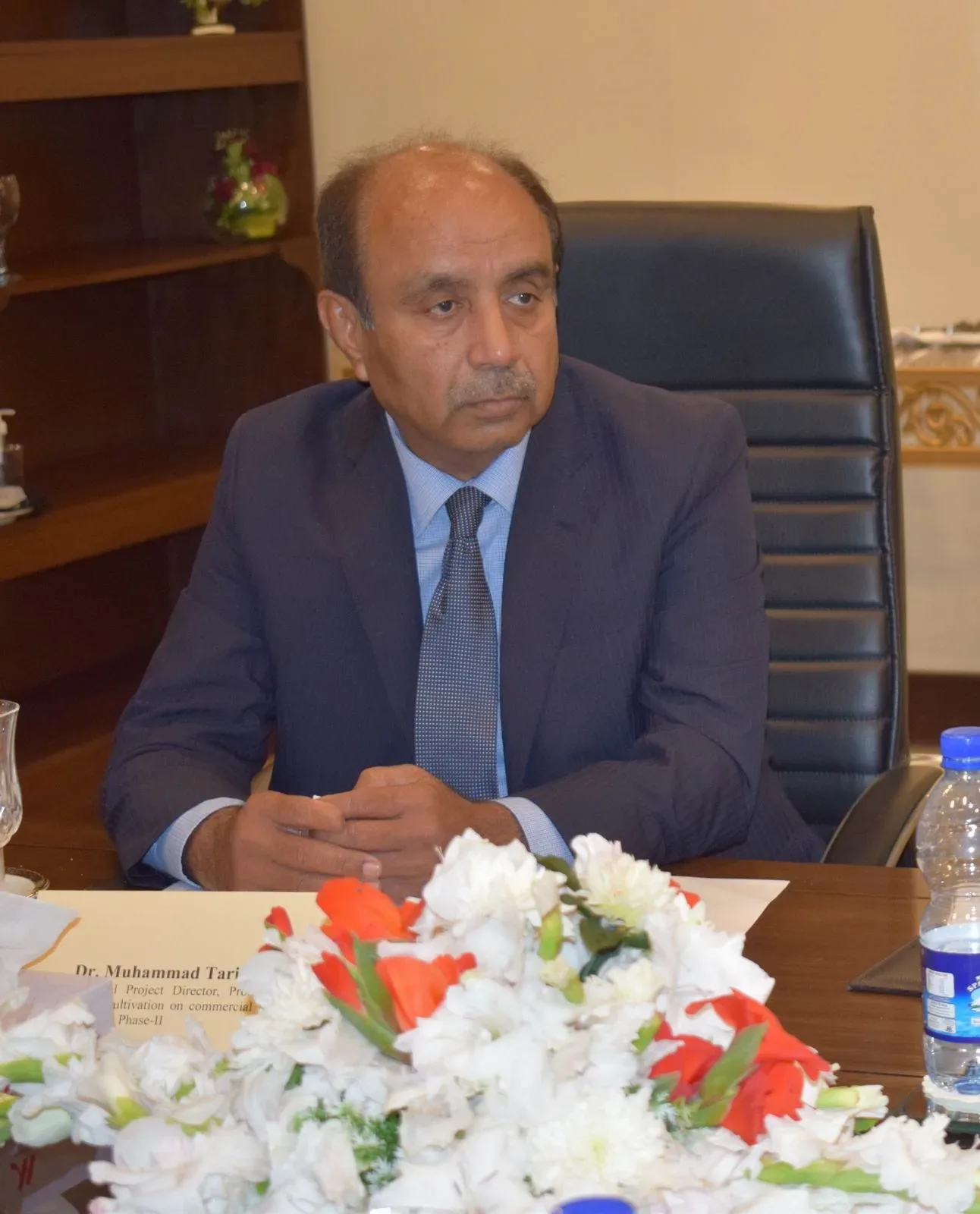
Muhammad Tariq (Ph.D)
National Project Director
Olive Promotional Program in Pakistan
Ministry of National Food Security and Research, Islamabad
Profile:
Muhammad Tariq is a distinguished professional having vast diverse experience in the field of agriculture,
project management, research/innovation and administration. He graduated in Agriculture, followed by M.Sc.
(Hons.) and Ph.D. in Plant Breeding & Genetics, from the University of Agriculture, Faisalabad,
Pakistan.
With a career spanning over three decades, He has held key positions in the agricultural sector,
particularly in the areas of oilseeds, maize, millets, resource conservation, climate resilience
agriculture, high-value crops and innovative technologies. As a team leader, he has been instrumental in
providing visionary guidance and direction for planning, executing research and development programs in
the
public sector harnessing Pakistan’s immense agricultural potential.
Various national, international collaborations and partnerships were established for the implementation of
targeted R&D initiatives in different disciplines. He has proven record of geƫng substantial grants
from various agencies and institutions to support these programs. As part of his commitment to knowledge
dissemination, he has effectively transformed research-based findings and technologies through
publications,
print media, electronic media, and other channels (227 in total).
He has played a pivotal role in evaluating the adaptability and commercial potential of drought-tolerant
crops like Olive, Pistachio, Avocado,Berries, Kiwi, Saffron, and Quinoa in rain fed regions. His efforts
have contributed to the development of 19 high-yielding, disease resistant and climate-resilient varieties
of several high value crops.
The most significant achievements include the commercialization of promising high value, low delta crops
such as Olive, Grapes, and Peaches to the marginalized rural communities in Pakistan. By adopting a
multidisciplinary approach, he aimed to enhance water and land productivity, improve economic returns and
address environmental challenges like soil degradation, carbon sequestration, and global warming. He has
also commanded the testing and introduction of various technologies, including conservation agricultural
practices, water saving techniques, watershed management, vermicomposting, and sustainable land management
practices to combat desertification in arid regions. In this regard he has executed 33 projects.
He is also recognized for successful transformation of resource poor, degradation prone Pothwar region of
Pakistan into a thriving hub for olive cultivation during his tenure under the Government of Punjab.
Approximately
1.9 million olive plants were cultivated, accompanied by comprehensive value chain
development. This initiative has had a profound impact on the eco-geographical environment of the area and
significantly improved the
livelihoods of rural communities. As the program leader of the National Olive
Initiative in Pakistan, Dr. Tariq is currently overseeing the commercialization and up scaling of emerging
olive sector, with cultivation expanding to more than 3.5 million plants across all provinces and regions.
Around 10,000 farm families are benefiting from olive cultivation, and there is substantial potential for
further growth. The olive commercialization program has an immense monitory significance and has far
reaching impact on social, environmental and livelihood improvement.
In order to boost olive sector, he has the credit of strengthening processing capabilities, tissue culture
laboratory, modern nursery raising, value addition facilities, weather monitoring, and the establishment
of a National Reference Laboratory for olive oil quality. Additionally, he has been actively involved in
creating awareness among stakeholders about the significance of olive crops, particularly in the
production
of pomace oil, cellulose organic dyes, ethanol, pellets and nutraceutical products. His efforts have led
to
Pakistan’s connection with the International Olive Oil Council and other olive organizations, establishing
the country as a recognized player in the global olive industry.
Based upon his work and contributions he was nominated for the prestigious award of Sitara-e-Imtiaz by the
Government of Punjab during 2024. In addition, he has also been conferred Top Ten Productive Scientist of
Pakistan Award and Research Productivity Awards during 2012, 2014 and 2017 to acknowledge his career
achievements.